Prices shown in USD are estimated at today's exchange rate. Taxes and import duties are not included.
A diamond is judged on more than the four C's. Cut, colour, clarity, and carat weight are the starting point, but what actually decides how a stone looks and lives on the hand goes further. Here's what we look at, and what we think you should too.
Round brilliant remains the most popular cut for its brilliance, but it's far from the only option. Pear, marquise, oval, princess, cushion, radiant, Asscher, heart, and emerald cuts each throw light differently and suit different settings: shape is as much a style decision as a technical one.

Clarity measures how clear a diamond is, specifically the presence of natural inclusions formed inside the stone. Labs like GIA grade clarity on a scale from FL (Flawless) down to I3, with Flawless at the top and each step below carrying more visible internal characteristics.
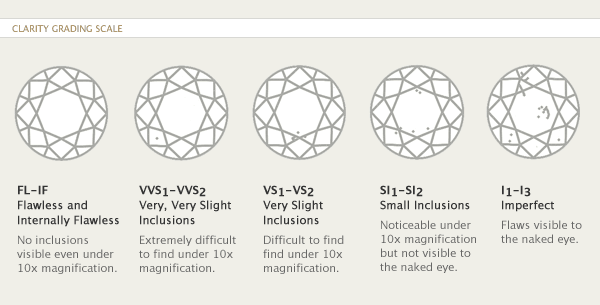
Why does "eye clean" matter more than the clarity grade on paper?
A diamond is eye clean when its inclusions can't be seen without magnification. Stones graded SI1 through I3 often fall short of that: the flaws show up to the naked eye and dull the stone's overall beauty. We'd steer you away from any diamond that isn't eye clean, regardless of what the certificate says.


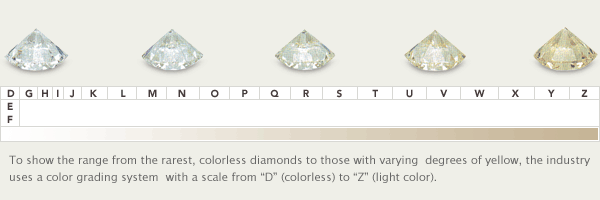
Colour grading actually measures the absence of colour. A perfectly colourless diamond sits at the top of the scale and commands the highest value: the closer to colourless, the rarer the stone.

Carat is simply the unit of weight used to measure a diamond, not its size in the way a millimetre measurement would be. Two diamonds of the same carat weight can look noticeably different in size depending on how they're cut.

What is fluorescence, and should it worry you?
Some diamonds glow or shift colour under ultraviolet light: sunlight and fluorescent bulbs both trigger it. That reaction is separate from the diamond's actual body colour and only shows up under UV.

Fluorescence under UV light is graded in five tiers, from strongest to none: Very Strong, Strong, Medium, Faint, and None.
The upside: fluorescence can make a diamond face up a shade whiter than its graded colour. An H-colour stone with medium fluorescence, for instance, can read closer to a G.
The downside: the effect isn't consistent from stone to stone. In some diamonds it dulls the brilliance and gives the stone a hazy, milky look rather than a whiter one.

What's actually different?
Origin, first and foremost. A natural diamond formed in the earth over billions of years, while a lab-grown one is grown above ground in a matter of weeks. Both are graded on the same 4Cs scale, and every lab-grown stone we offer carries the same independent certification, GIA or IGI, as our natural diamonds, with nothing self-graded by the grower.
But origin isn't the whole story. Natural diamonds carry a history no lab can compress into weeks, and it often shows in the way a stone catches light, and in a character that comes from conditions no two natural stones share. Lab-grown stones can look almost too perfect by comparison, with a flatter, more uniform lustre next to a natural stone's fire; a trained eye can often tell the two apart. That's part of why natural remains the heart of what we do, and the choice most of our clients still reach for. Lab-grown is a genuine, certified option for a diamond centre stone at a different price point. It just isn't a substitute for the real thing.
We believe in showing you exactly what you're buying: real photos and video of the actual stone, its eye-clean status, and how it performs, so you can shop online with the same confidence as standing at the counter.
Just for you, to compare later. Saved on this device only, not sent to us.